Arthur Hayes' Trifecta essay: Flop as the compute price benchmark
Arthur Hayes' Oct 26 essay The Trifecta pitches Flop's spot compute price as a global benchmark and sketches FCU forwards, FRCR futures and a perp built on it.
Arthur Hayes published a new essay, The Trifecta, on October 26. It argues that the price agents pay for compute on Flop Network will become the global reference price for compute, and it sketches the derivatives that could be built on that price. Hayes shared it on X at 23:09 UTC, calling it his "latest essay on how @flop_labs compute spot market will become the reference price for all compute focused derivatives."
The title is his scorecard. Hayes lists the perpetual swap, which he says he and his BitMEX team invented in May 2016, and the synthetic dollar idea from his March 2023 essay "Dust on Crust", which he credits Ethena with building. The Flop Network spot compute market is the third, and he marks it "TBD". He calls the essay "a definitive blueprint for any intrepid entrepreneur" who wants to build a compute derivatives market, so read the contracts below as his proposal. Flop Labs hasn't announced any of them as a product.
"The Trifecta" my latest essay on how @flop_labs compute spot market will become the reference price for all compute focused derivatives.
"This summer, I unveiled my idea for the Flop Network. FLOP is food for your AI agent. Agents will use FLOP in commerce because FLOP is https://t.co/B67YxPLc2s
— Arthur Hayes (@CryptoHayes) October 26, 2026How does Flop produce a compute price?
Hayes starts from the claim that "there is no global price for compute." Existing indices track chip sale and rental prices or per-model token prices, and he sees both as derivatives of compute itself. In his telling, Flop produces a block every second, and each block holds receipts proving a miner finished an inference task for an agent. Each receipt carries three numbers: the latency in seconds, the floating-point operations completed and the $FLOP fee the miner earned. Dividing the fee by the work and then by the latency gives a $FLOP price for compute per second.
He argues it only counts as a real spot price because anyone can trade it. Anyone with a GPU, CPU or TPU can mine by serving inference, and anyone holding $FLOP can submit a request.
What is a Flop Compute Unit (FCU)?
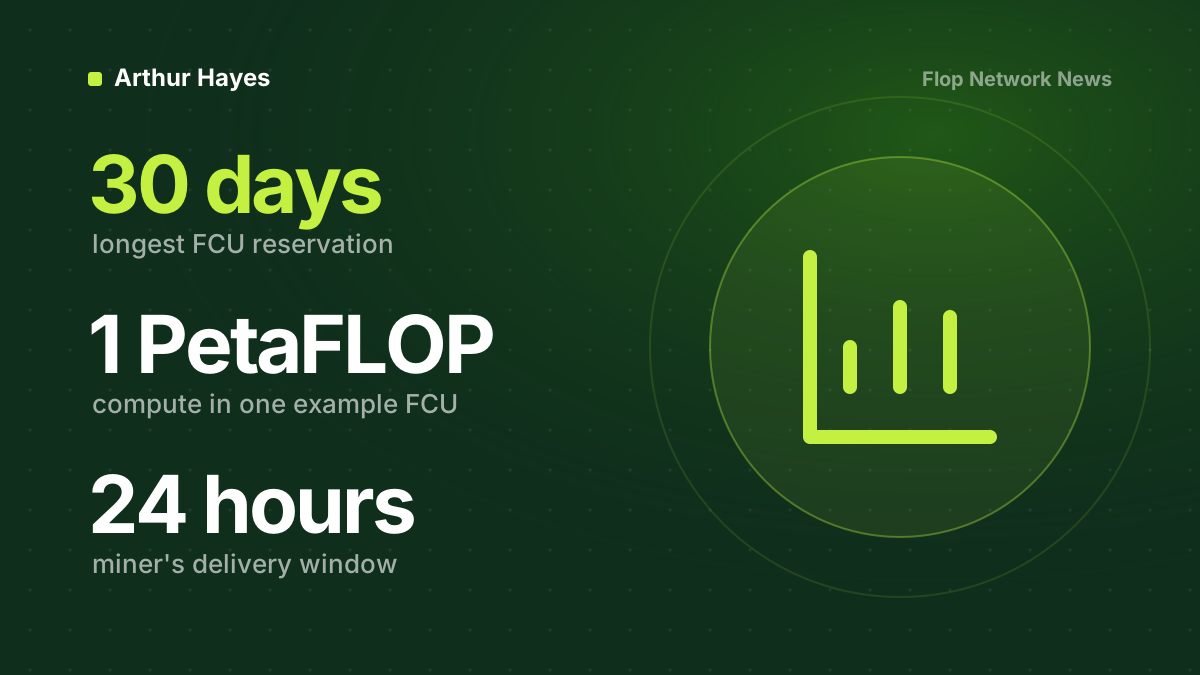
The essay calls Flop's forward contract a Flop Compute Unit. A buyer reserves compute from a miner for delivery up to thirty days ahead, and the miner then has 24 hours to deliver. Hayes describes the accepted reservation as "akin to a deliverable forward" that the holder can resell on the network if they no longer need it. His worked example is one FCU of 1 PetaFLOP with a 1-second latency, a model picked by the buyer and delivery at 12:00 UTC seven days later. He says FCUs cover inference only, not training, and that each model would have up to 30 tradable FCUs, one per day.
Bids have to be fully funded. Sellers post a $FLOP bond "well in excess" of the fee, sized by the network from recent inference volume, and a miner who misses the 24-hour window loses the whole bond while backup miners bid to finish the order. If nobody delivers, the buyer gets a full refund plus the bond. Hayes says the order book and matching run off-chain and funded orders settle on-chain, with no FCU trading fees beyond the normal validator fee.
This is the same idea the FLOP whitepaper draft calls a Compute Reservation Unit, which we covered in our compute futures explainer. The names differ between the two documents, and Hayes tells readers to "monitor changes to the official Flop docs, which will contain all this information."
FRCR futures and the FRCR perp
For traders who want dollar exposure without handling compute, Hayes proposes the Flop Reference Compute Rate (FRCR), an "hourly, volume-weighted $FLOP/GigaFLOPS print." On top of it he specs a quanto quarterly futures contract that expires at 12:00 UTC on the last Friday of March, June, September and December, with USD margin and a multiplier of 1 USD per point. He also specs a quanto perpetual swap whose funding comes from an 8-hour TWAP of the gap between the perp price and FRCR. The contracts are quanto because the underlying market is priced in $FLOP while most traders want to post and earn dollars.
His argument for why market makers could quote these is that they can rebuild the exposure from FCUs. A long position means buying a 30-day FCU and rolling it into the next one, and a short means supplying FCUs and rolling them before delivery so no chips are needed. The 100 and 200 $FLOP figures in his worked examples are illustrations of the arithmetic, not price forecasts. FRCR would also publish per-model buckets next to the composite, which Hayes says turns model deprecation into the main risk hedgers manage.
When could any of this exist?
The essay gives no dates. The whitepaper marks the reservation design as "ratified as protocol design; implementation planned after the core protocol," and there is no FLOP token yet. The testnet's working target is still Tuesday, November 3, 2026, according to the Flop docs timeline FAQ, with mainnet tracking to early February 2027. Our FLOP roadmap follows each date.
For now, the way to take part is serving or buying inference once the testnet opens, which our how to mine FLOP guide and what is FLOP explainer cover. Hayes' other Flop appearances are logged on our Arthur Hayes and Flop page. Anyone selling FLOP futures, FCUs or FRCR contracts today is not official.
Source posts on X
"The Trifecta" my latest essay on how @flop_labs compute spot market will become the reference price for all compute focused derivatives.
"This summer, I unveiled my idea for the Flop Network. FLOP is food for your AI agent. Agents will use FLOP in commerce because FLOP is https://t.co/B67YxPLc2s
— Arthur Hayes (@CryptoHayes) October 26, 2026Sources
Get the weekly Flop digest
One short, sourced email a week covering testnet, airdrop, Technocore and Flop Labs news. No hype.
We'll only email Flop news. Unsubscribe anytime. Privacy
Spotted an error? Read our editorial policy. Unofficial community site. Not affiliated with Flop Labs. Not financial advice.